Showing posts with label London Trip. Show all posts

Saturday, February 21, 2015

Adventures in London- Part 4- Wednesday

Precursor:  An unbelievably busy few weeks in my non-horsey life has seriously eaten away my barn time, leaving me with no posts or pictures of interest to share.  In addition to that, I spent the first half of this week on a trip to New York City with a very full schedule.  I very nearly wrote a post about what I saw at the Met, but decided to instead resurrect another nearly-finished-but-never-published museum post from my drafts.  Enjoy! 

I really need to write these London posts already before I lose what little momentum I have left on them, so be prepared for less detail than my previous posts.  Also, almost all of these pictures were taken at the British museum, where I was apparently not very good at taking pictures of descriptions of artifacts, so excuse the occasionally vague descriptions.


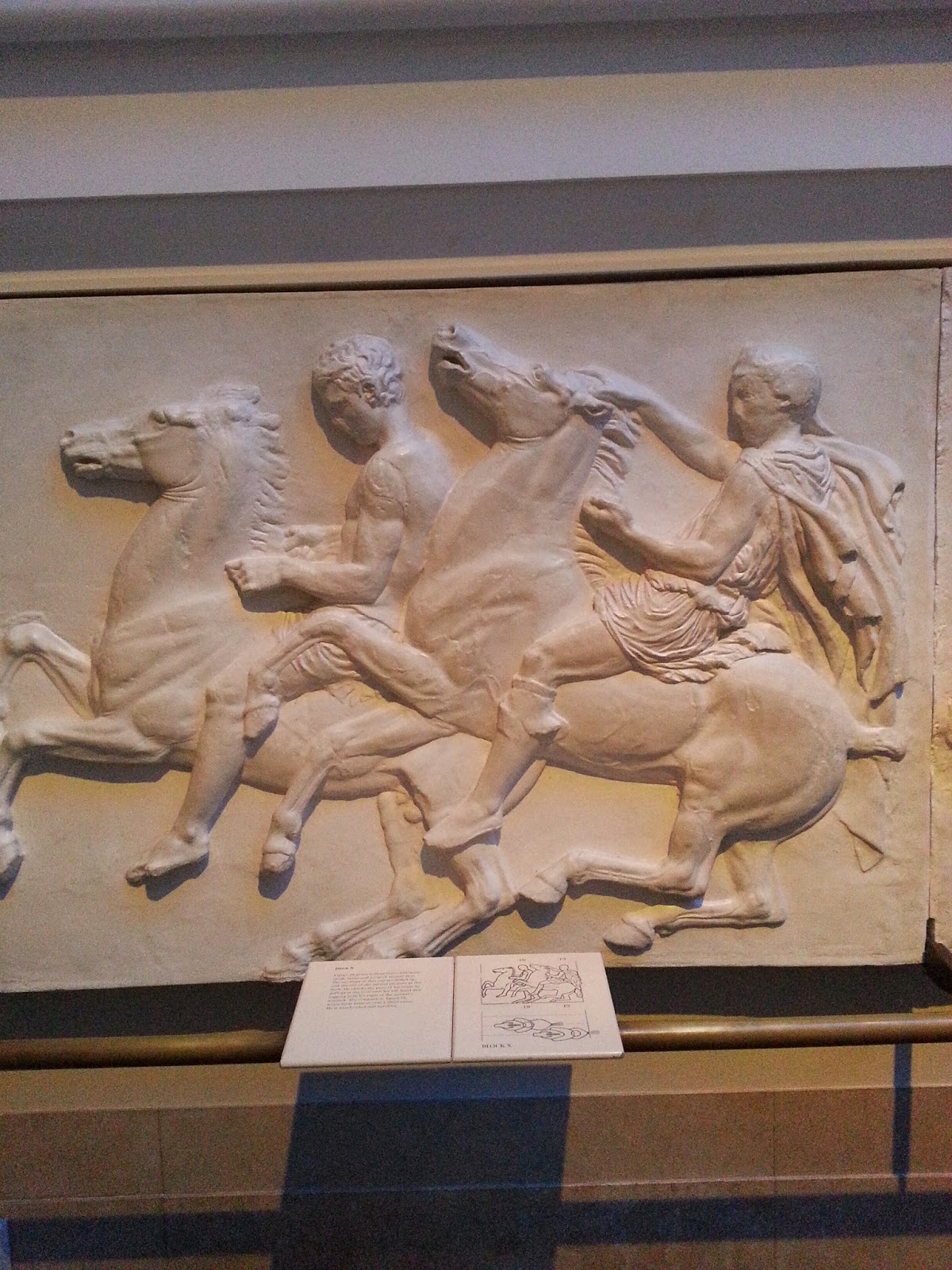
First up is a group of some sort of stone slabs depicting horses.  I thought these were the plaster castings of carvings from the parthenon, but I'm almost positive the parthenon ones are below.  Your guess is as good as mine.  I'm about 90% sure these are Greek.  
Apparently they didn't teach convoys of horses to leave a horse-length between their horse and the carriage in front of them in ancient Greece.


There were also many beautiful examples of Greek pottery. This type of pottery was known as red figure pottery, because the figures were the reddish-brown color of the clay.  The pots were painted everywhere except where they wanted the people (and horses) to go.  This was a newer style that became popular after the black figure style, which was just the opposite.  The figures were painted in black paint, leaving details such as the eyes in the natural color, as well as the rest of the pot.


Okay THESE are the plaster castings of carvings from the Parthenon.

The concept of naked riding just seems wrong somehow.  This carving depicts the lesser known Lord Godiva.

As much as any horse is cute, this horse is not cute. 

Whenever my horse stops to scratch like this while I'm riding, my trainer calls it an emergency itch.

Maybe your horse wouldn't be acting up so much if you had your heels down.
This next one was from some other temple that escapes me.

This was one of the top ten pieces the map recommends you see.  It's map approved.
If I remember correctly, it's the head of a chariot horse from the moon goddess' chariot (I think)

Scary parrot mouth
Technically these next statues aren't horses, but my blog has a place for the awesome and hooved.  The section on Assyria had lots of great horses in some of the better preserved stone in the museum.
"Khorsabad The Palace of Sargon

This area Mainly contains sculptures from the city and palace of Khorsabad, built for the Assyrian King Sargon II (721-705 BC). The pair of human-headed winged bulls stood originally at one of the gates of the citadel, as magic guardians against misfortune."


"Attack on an enemy town

Assyrian, about 865-860 BC

A high official, wearing an ankle-length coat of scale armour, shoots towards an enemy town.  A chariot waits behind, while a vulture plucks at the body of a dead enemy."


"Crossing a river

Assyrian, about 865-860 BC

Ashurnasirpal's boat is rowed across the river and hauled ashore.  The royal chariot is beside him and his horses swim behind. An attendant draws the king's attention to the captured town that appears on the next panel to the right."

There were also many panels depicting the lion hunt, which I apparently did not document the descriptions of.  


The african art also featured horse-shaped objects.


As did the Asian art


See the horses?


This next piece is technically not horse related, but it's incredibly beautiful and so delicate it shook whenever someone walked nearby.  

"Gilt silver openwork and filigree crown inlaid with kingfisher feathers and hardstones (some missing)

Late Ming-early Qing dynasty, 17th century AD

The decoration of this ornate crown of 'cage' construction includes flower heads, flaming pearls, dragons and phoenixes.  It would have been worn by a lady of high birth.  

Not all the horses I saw were exactly what one might call conventional...

exhibit A

Exhibit B
I also spied this bit in the exhibit on ancient Syria.

"Horse Riding

This horse bit has large bar cheek-pieces for attaching the bridle and holes for the straps.  The knobbed snaffle must have been uncomfortable for the horse but enabled the rider to control it with the slightest movement of the reins. There are considerable signs of wear at the junction of the two rings in the centre, indigating that this object had been extensively used before it was buried."


I was not good at documenting signs to remind myself of which exhibit was what on the latter half of my museum trip.  So I'm fairly sure all these photos came from the area devoted to the areas around ancient Syria and Iran. 


"Stone relief showing horses

This fragment was originally part of a larger Assyrian relief showing a team of horses drawing a chariot. The Assyrians campaigned regularly in western Iran during the 9th and 8th centuries BC, and horses were among the items of booty that they particularly valued for their chariots and cavalry."


"The Cordoba treasure

Important hoards of silver artefacts were deposited in the Iron Age, and hte example displayed here was found by chance in 1915 at the Molino de Marrubial, on the outskirts of Cordoba.  The objects had been buried in a pit, the coins and two lumps of silver were in the bowl with the rest of the hoard outside.  The treasure includes a torc, eight armlets,the head of a brooch (in the form of a pair of horse's heads), rough lumps of silver and other fragments. The coins, 82 native and 222 Roman, show that the hoard was buried about 100 BC. Some of the objects are damaged and distorted, and the hoard might well have been the stock of a silversmith."


Last but not least of the artifacts was the Lewis Chessman, another of the museum's top ten.

"The Lewis Chessmen

In 1831 a remarkable hoard of carved walrus ivory was discovered on the Isle of Lewis in the Western Isles, Scotland.  It consisted of 93 pieces and included 78 chessmen, 14 large gaming counters and an elaborately carved belt buckle.  Eleven of the chessmen are at the National Museum of Scotland, Edinburgh and the rest of the hoard is at the British Museum.  When found, some of the chessmen were stained red. The earliest medieval chess sets appear to have combined red with plain ivory rather than black and white pieces familiar to the game today."

The day ended off really rather well with a tour of Buckingham palace! No pictures were allowed inside, but suffice it to say it was amazing.  We were allowed to snap a few pictures in the garden out back.


Wednesday, September 17, 2014

Adventures in London part 3- Tuesday

a.k.a. Wordful Wednesday

a.k.a. real horses finally! 

With my hotel situated about a five-minute walk from the HouseHold Cavalry, it was inevitable the family would have to wake up and watch the changing of the horse guards at some point.  Unfortunately, our morning got away from us over a leisurely breakfast, and we arrived barely before it started, meaning a large crowd had accumulated.  We did manage to find a decent spot to wait and watch.  


The first horses we spotted were police horses, reminding people to stand behind the marked lines because the horses would by no means stop or avoid their tourist toes.  

I took a few pictures of this big bay police horse.  What a cute face! 


Finally we heard several more hooves approaching, and the cavalry guards were visible at last!

Not that they were terribly visible over the tourists.  


Business in the front, business in the back.  These were very businesslike horses.  


"What are you looking at?"
 Then this guard came out mostly to move the guests out of the middle alley.  Check out those boots!
I bet you could impale yourself on the point of those boots.  


If not the boots, the sword would definitely be capable of impaling you.  

The guardhouses here are naturally much bigger than the famous Buckingham palace ones.  These ones need to fit a horse! 

Close up of this horse's cute face! I suspect my expression mirrored that of the small child in the stroller's. 

This horse was very fidgety with his bit and kept sticking his tongue out


"Psst, human! I think that kid in the stroller might be a security threat." 
Ever vigilant.  

Notice the VERY fluffy sheepskin saddle cover
 The newly arrived horses did some synchronized cavalry-esque stuff, none of which I could really see in all honesty. It was very crowded.   If you scroll back up you'll notice the incoming guards all had red coats with white sheepskin saddle covers(? I can't imagine what else you would call them), and those who left were already there with their woolly black saddle covers (and matching black coats).


Look how woolly

So.  Woolly. 

This might possibly be the most awkward picture I've ever taken of a horse.  It's got the mid-blink going on with the teeth sticking out.  Majestic creatures, horses.  


Those are some serious boots.  

Seriously serious boots.  

"Help there's tourists in my face"
 Then, the guards in the courtyard gracefully dismounted at the same time on a command.
A view of the saddle sans rider.  That's a serious pommel.  


That is one unimpressed looking tourist.  
 Of course, the main event was yet to come.  The household cavalry has a MUSEUM!

Dem boots.  


"Practise makes perfect

A trooper takes at least 10 hours to prepare for daily inspection.  Cuirasses (breastplates) and helmets are cleaned with Brasso and chalk brushes.  Leather straps fixing the sheepskin cover to the saddle are brushed with shoe whitener. Each buckle hole must be cleaned out with a nail. 

Breeches are 'whit-sapped' while worn; jackboots are soaked in beeswax before being smothered in layers of black polish.  Wire wool is used to rub out any imperfections on the leather surfaces.  

The horse's hooves are brushed with oil and their white legs chalked up.  Using a furnace, farriers make and fit shoes for each horse.  The whole kit including saddles, collar chains, sword slings, plumes and cuirasses must be fitted correctly.  If the helmet is too loose, it tips back.  Too tight, it causes an unbearable headache.  The inspection is taken by the Adjutant. The trooper graded best is awarded guard duty in the sentry boxes, with the worst carrying out guard duty dismounted."  

Apparently it's top honors to stand out front in the guard houses! I guess that dismounted guard from earlier had an unsatisfactory kit.  


"Shabraque (saddlecloth) with a black sheepskin cover, as worn on an officer's horse of The Blues and Royals.  These are only worn when the Sovereign or members of the Royal Family are present.  They are made from fine red cloth and cut to a regimental pattern with pointed ends (those of the Life Guards are rounded) with a gold lace border. The Monarch's Crown and Garter Star, with battle honours richly embroidered in scrolls appear on each corner." 

So wooly.  I really wanted to touch them and probably easily could have, but I've had too much 'don't touch anything in a museum' programmed into my brain.  

This was the best I could do picture-wise.  The saddle rack was significantly taller than I was.
"Officer's Pattern Saddle

This design was in use from 1918 until it was replaced in 2003.  It has extended fans at the rear and broad points at the front arch which help to distribute the weight of the rider and his kit evenly across the horse's back.  Saddle panels are stuffed with wool and made of leather which is stained brown on top but left unstained on the underside where contact is made with the horse.  The seat is made of hog skin and the skirts and saddle flaps are made from solid skirt hide with hog skin print."

This was the matching bridle.  It was essentially the same as the current one, but simpler.  Still had the fancy crownpiece and bit shanks.   


"Life Guard Officer's Saddle

Life Guard officers wear a bearskin over their saddle while Blues and Royals officers wear an astrakhan cover.  At the front of the saddle under the bearskin there are two rubber pistol pouches where the officer would have kept his pistols when mounted but pistols are no longer carried on parade today." 

Mmm that's good photography.  
"The Other Ranks Saddle

The saddle on display has been in service since the early 1900's.  It has a laminated beech wood tree with steel arches at the front and rear.  The saddle is webbed and has a blocked seat made from the same kind of tough leather that you would find on the soles of your shoes.  The girth attachments can offer slight adjustments to the unique curves of each horse.  The various brass fittings were used to attach swords and rifle buckets."


"Saddle used at the battle of Waterloo by an officer in the Blues.  Officers had to provide their own horses and saddlery for military duty."


I really don't want to re-write all three captions when this photo is clear enough to read anyway. 


"The Zetland Trophy, 1874

When Lord Zetland left The Blues in 1874, he failed to give the customary leaving present to the Officer's Mess.  When he was asked about this omission, the wealthy Zetland casually remarked, 'Oh, buy a piece of silver and put it on my bill'.  The officers took him at his word and duly commissioned this enormous table centerpiece. It took four men to lift it and cost them the then astronomical sum of £1000.  The central column depicts The Blues at the Battle of Waterloo, topped by a figure of Mars, the god of war."

This was definitely my favourite non-horse memorabilia in the museum.

"Officer's winter dress frock coat

Worn by Colonel Frederick Burnaby while serving with the Royal House Guards (the Blues), 1859-1885.  He was a giant of a man, 6 feet 4 inches tall and weighing well over 20 stone. He was extraordinarily strong, and worked out regularly in a London gym lifting weights, something that his brother officers found rather odd."

I can't imagine wearing something so fancy to ride a horse, but then I'm not a 19th century cavalry officer.


"Universal Pattern Saddle

with sword and Lee Enfield rifle, 1902-1914.  This saddle was designed to spread the burden more evenly across the horse's back.  Each man carried the .303 Lee Enfield rifle in the rifle bucket on the off-side, with thirty rounds of ammunition in a bandolier over his right shoulder.  A further sixty rounds were carried around the horse's neck.  A highly effective new sword, introduced in 1908, designed for thrusting, was also carried on the saddle."


There was a display of little cavalry figurines in formation.

One in particular caugt my eye. 

That is a little tiny miniature Queen Elizabeth II

For those not fans of miniatures, there was a slightly larger scale figure for the measly sum of  four hundred and twenty pounds ($685)